Case study · Independent project · Solo
BidData EduPredict
University management system with three prediction services.
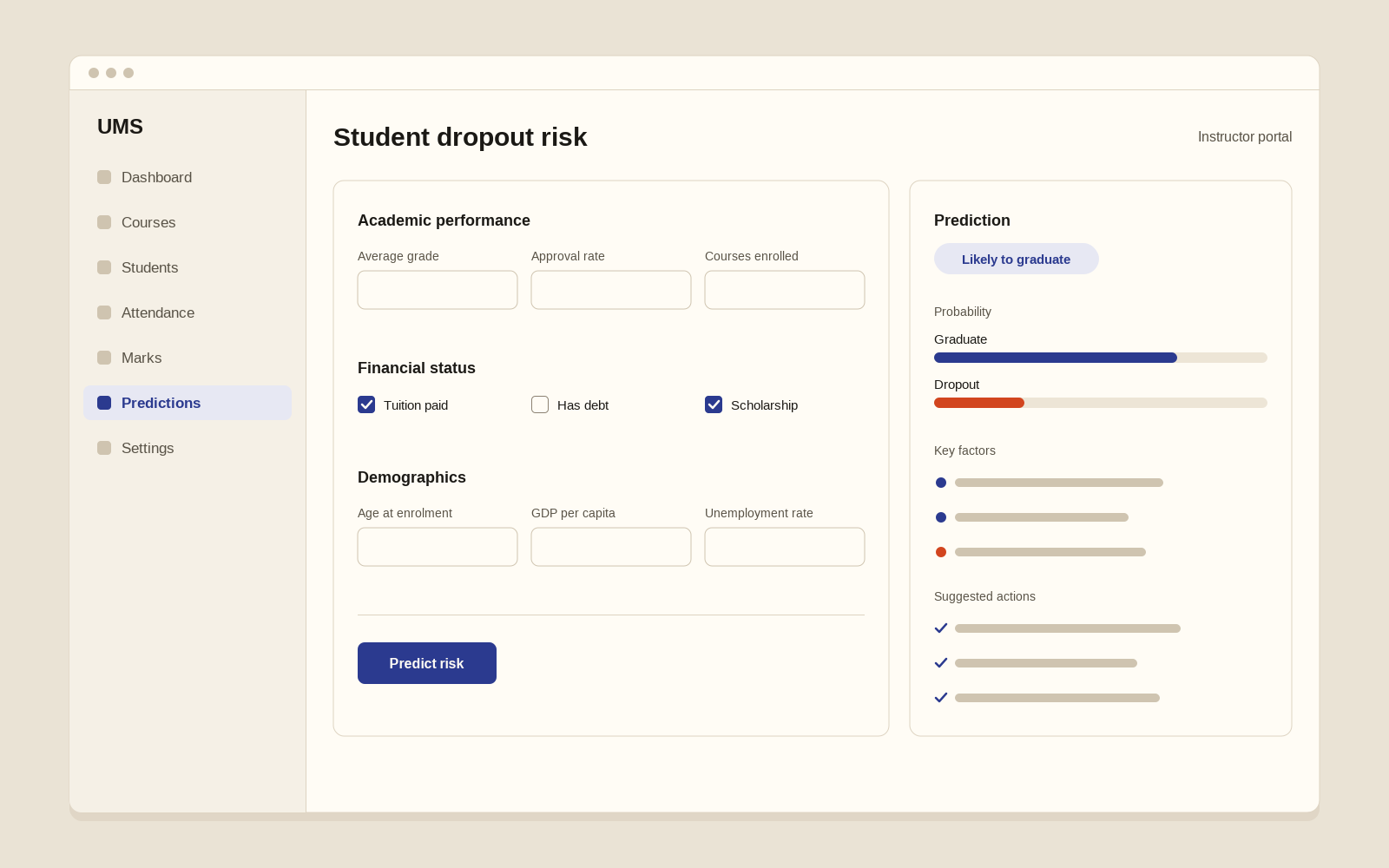
Admin, instructor and student portals for courses, attendance and marks, with Flask services that predict grades, dropout risk and course demand and explain each result.
Problem
Instructors usually learn that a student is struggling, or about to drop out, only after results are final.
What I built
- Portals for admins, instructors and students, with courses, enrolment, attendance and marks.
- Instructors decide which marks and attendance records each student can see.
- A grade predictor: a gradient-boosting model estimates a final grade out of 20 from 26 inputs plus 4 values calculated inside the service.
- A dropout-risk predictor: a random-forest model gives the probability that a student drops out.
- A course-demand predictor: an XGBoost model suggests the most likely of 17 courses for a student profile.
- An admin page with charts showing which inputs matter most to each model.
Architecture and key decisions
- One service per model
- Each model runs as its own Flask service, so one can be updated or replaced without touching the others.
- Every prediction explains itself
- Each response includes the top factors, a confidence level and a recommended action, so instructors can see why a student was flagged.
- Public training data
- The models are trained on a public dataset of more than 4,400 student records (UCI, Predict Students' Dropout and Academic Success).
What I learned
- A prediction is only useful if people can see why it was made.
- Separate model services made the system easier to change than one large one.