Case study · Final-year project · Team
Edmin
University administration platform for admins, faculty, HR and students.
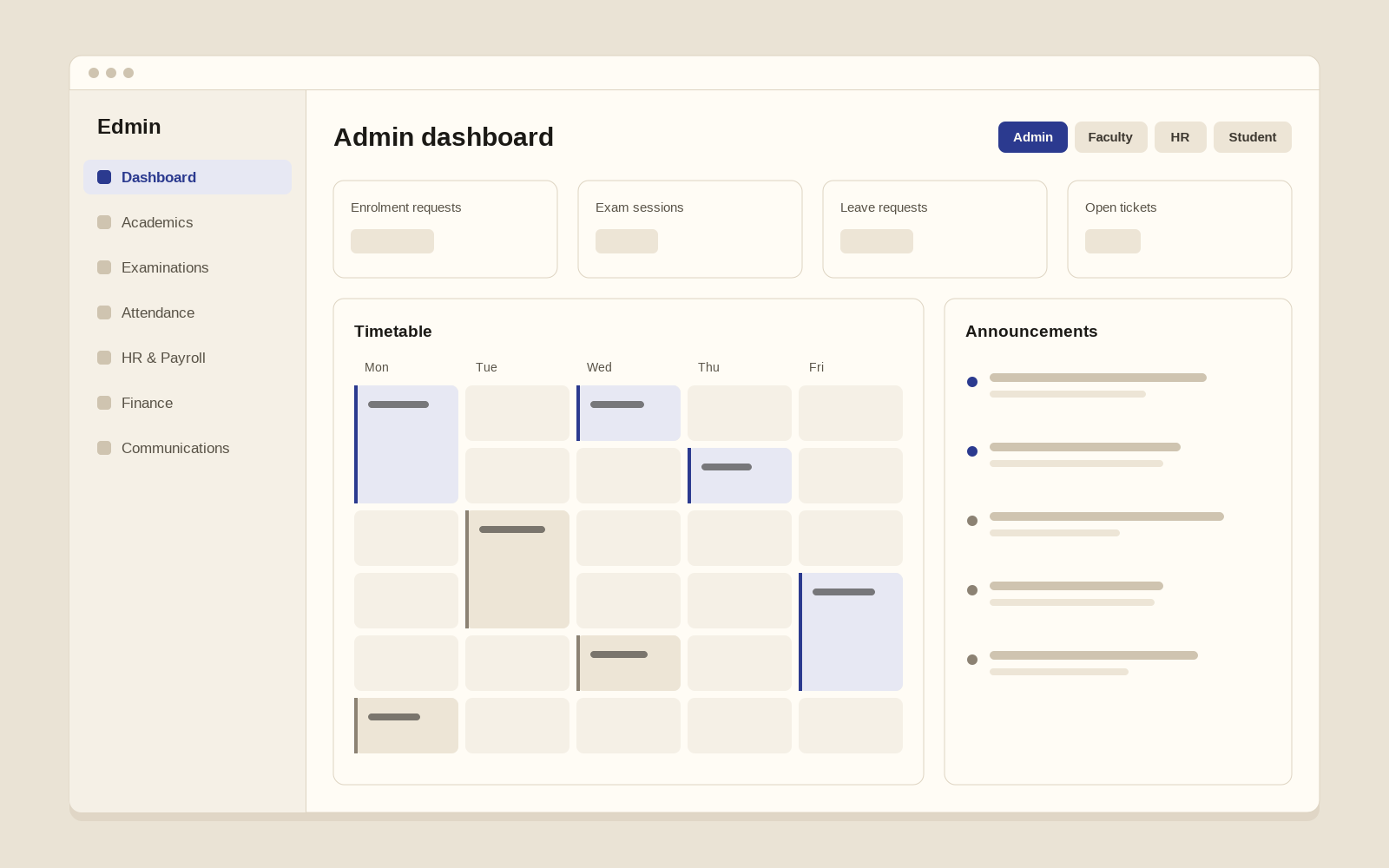
Role-based dashboards for academics, exams, attendance, HR, payroll and finance in one system, built on a layered Express API, PostgreSQL and Redis-backed background jobs.
Problem
A university's academic, HR, finance and examination work touches the same people and records, but each role needs a different view of them and different permissions.
What I built
- Accounts and access: JWT sign-in, permissions by role and an audit log.
- Academics: programmes, curricula, course offerings, enrolment requests and timetables.
- Assessment: assignments, a quiz bank, AI-generated quizzes, exam sessions and grade boundaries.
- Attendance for students and faculty, with correction requests.
- HR and payroll, plus finance: fee plans, invoices, instalments and scholarships.
- Communications: announcements, support tickets, complaints and an AI-assisted academic chat.
Architecture and key decisions
- Permissions stored as data
- Roles, permissions and the links between them live in database tables instead of a fixed list in code, so adding a role needs no code change.
- Outbox pattern for side effects
- Notifications and emails are written as outbox events and processed by BullMQ workers, and processed events are recorded so duplicates are skipped. A failed email never fails the user's request, and it is not lost.
- Layered API
- Requests pass through routes, controllers, services and models, with self-contained domains such as identity and notifications in their own modules.
- Feature-first frontend
- Each feature keeps its own API calls and React Query hooks, and each role gets its own dashboard area.
- Hardening and tests
- Helmet security headers, Redis-backed rate limiting, Zod request validation and Pino logging, with Jest and Supertest for the API and Playwright for end-to-end tests.
What I learned
- Modelling permissions as data takes more work up front, but it kept new roles out of the codebase.
- An outbox makes every side effect explicit, which made it clear what could be retried safely.